
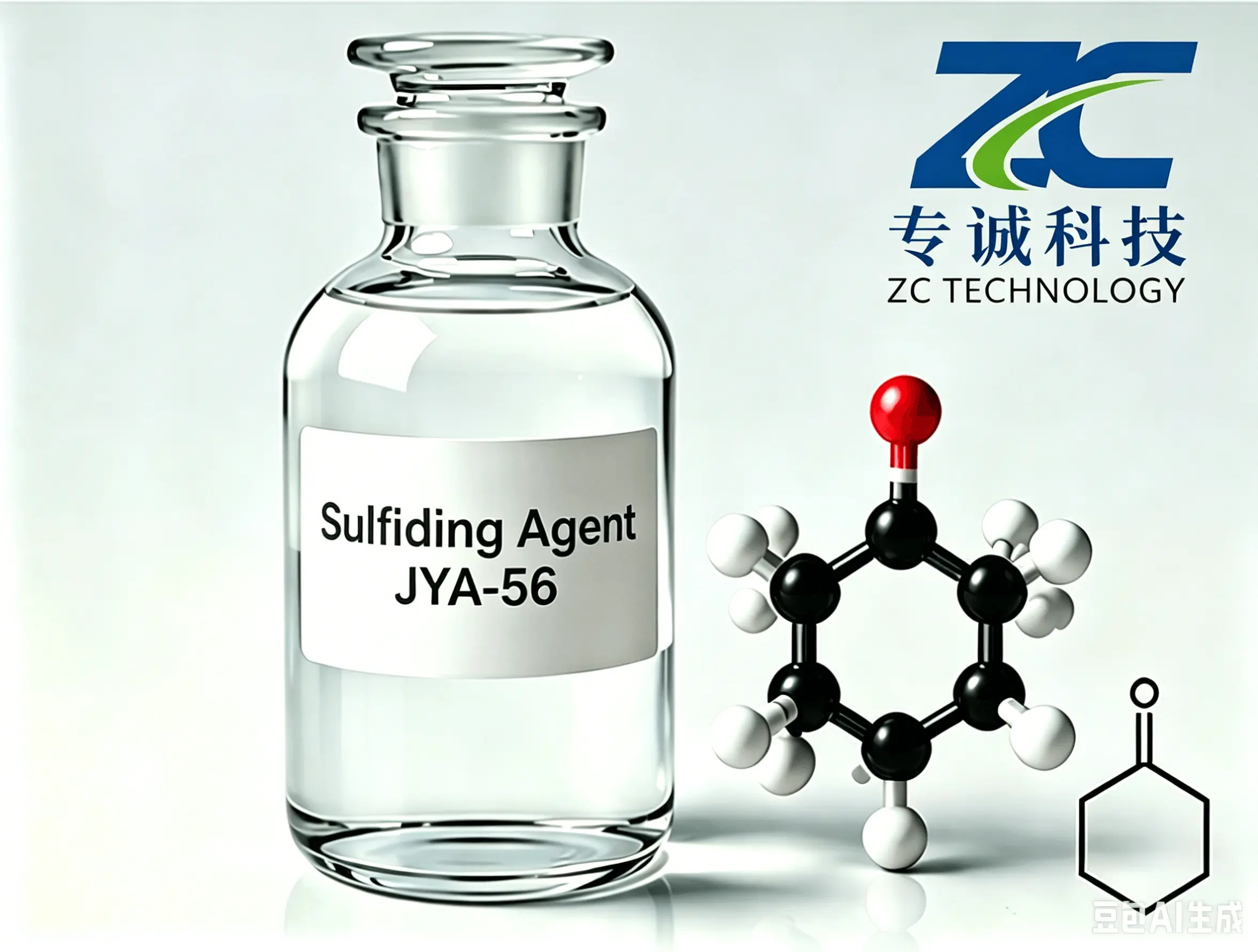
JYA-56 DI-TERT-BUTYL-POLYSULFIDE
JYA-56 ditert butyl polysulfide is the result of collaborative innovation by Dongying Junyuan Petroleum and holds several technology patents. It is a non-flammable liquid with a high flash point, robust safety features, and a more friendly odor.
JYA-56 ditert butyl polysulfide finds extensive use in hydrogenation catalyst sulfiding, sulfur supplementation, and sulfur injection across various domains: oil refining, petrochemicals, coal chemicals, waste mineral oil regeneration, hydrogenated vegetable oil, and fine chemicals.
Additionally, ditert butyl polysulfide serves as a coking inhibitor in ethylene cracking furnaces, also known as Gas-Phase cracking furnace coking inhibitors.
As a new environmentally friendly and safe product, JYA-56 ditert butyl polysulfide stands out as an ideal green and reliable alternative to traditional dimethyl disulfide (DMDS) products.
Typical Specifications:
Technical Data of JYA-56 ditert butyl polysulfide
l Product Code: JYA-56
l Chemical Components: Di-Tert-Butyl PolySulfide
l Appearance: Light yellow to dark brown liquid
l Features: Environmentally and safer. Non-flammable, with friendly odor. Low toxicity.
l Molecular Formula: C8H18Sx
l CAS: 68937-96-2
| Items | Specification | Test Method |
| Flash Point (opening cup),℃ | ≥100 | GB/T 3536 |
| Appearance | Dark Brown or Tan Liquid | Visual |
| Odor | Friendly odor | – |
| Solubility | Insoluble in Water, Miscible in Alcohol, Ether | Visual |
| Density(20℃), g/cm3 | 1.09-1.18 | GB/T 4472 |
| Sulfur, %(wt) | 52-56 | GB/T 17040 |
| Freezing Point | ≤-40 | GB/T 510 |
| Ash, %(wt) | ≤0.05 | GB/T 508 |
| Kinematic Viscosity(40℃), mm2/s | To Be Reported | GB/T 265 |
| Initial Thermal Decomposition Temperature℃ | 125-150 | GB/T22025 |
Features of JYA-56 ditert butyl polysulfide:
Performance data-JYA 56 ditert butyl polysulfide vs DMDS
| Typical Characteristics | DMDS | JYA-56 |
| Chemical Name | Dimethyl Disulfide | Di-tert-Butyl Polysulfide |
| Sulfur Content(%,wt) | 68 | 55 |
| Decomposition Temperature℃ | 200 | 150 |
| Flash Point℃ | 24 | 100 |
| Appearance | Light yellow liquid | Dark brown liquid |
| Odor | Offensive odor | Friendly odor |
| Density(g/cm3) | 1.06 | 1.09-1.18 |
| Freezing point℃ | -85 | -44 |
| Water Solubility | No | No |
| GHS | Flammable | None-flammable |
- Odor:
- DMDS (dimethyl disulfide) is highly volatile and has an extremely unpleasant odor.
- Tiny spills of DMDS can be distressing to workers and surrounding communities.
- JYA-56 has a milder and common smell. It remains stable under typical temperature and pressure, emitting a mild odor during loading and unloading. The operational environment is favorable, leading to a safer, cleaner, and more efficient process.
- Flammability and Storage:
- DMDS: Flammable with a low flash point (24°C), requiring extra attention during use, transportation and storage.
- JYA-56: Non-flammable with a flash point over 100°C. It significantly reduces production, transportation, and storage risks. The use of ordinary transport vehicles ensures practicality and also eliminates the financial burden and alleviates safety concerns.
- Material consumption and Environmental friendly:
- JYA-56 can participate in sulfurization reactions at around 150°C. It enables sulfiding reactions at lower temperatures. Shortens sulfiding time. Reduces energy consumption. Contributes to a greener, emission-reducing process.
- JYA-56 produces C4 butane instead of C1 methane, thus no extra waste gases or sulfur into flare. It helps maintain the purity of circulating hydrogen during the sulfiding process (maintained above 90%). Minimizes hydrogen usage and sulfur emission.
- JYA-56 experiences minimal H2S loss during the sulfiding process, boasts high utilization, and reduces the sulfurizing agent usage amount.
Attention:
Precautions of using JYA-56 ditert butyl polysulfide:
*Consult your catalyst supplier to calculate the sulfiding agent amount needed.
*Before using JYA-56 ditert butyl polysulfide, remember not to solely rely on the information provided here. It might not cover all specific uses or applications. Always seek additional guidance if needed.
- Injection:
During the early stages of sulfurization, it is essential to slowly and evenly inject the JYA-56 ditert butyl polysulfide .
Adjust the amount of JYA 56 ditert butyl polysulfide added during the sulfurization process based on the changing H2S concentration in the circulating hydrogen.
Avoid injecting a large amount all at once or performing concentrated and rapid injections.
- Hydrogen Circulation and Purity:
Throughout the entire sulfurization process, ensure there is sufficient hydrogen circulation.
The purity of the circulating hydrogen must be ≥85%.
- Forbidden:
Do not inject the JYA-56 ditert butyl polysulfide without sulfurization circulating oil.
Strictly avoid injecting the sulfurization agent into the circulating H2.
Transport information:
Delivery and Package of JYA-56 ditert butyl polysulfide
Via container or isotank. Small pacakges: 200 Liter/drum*80Drums, 1000 Liter/IBC tanker*20tankers
Storage of JYA-56 ditert butyl polysulfide
Store in a cool, well ventilated place.
Read more:
- Global manufacturers of TBPS Di-Tertiary-Butyl Polysulfide
- TBPS stands for Di-Tertiary-Butyl Polysulfide.
- Chevron Phillips produces TBPS as “TBPS 454”.
- Lubrizol Corporation identifies it as “Sulfrzol 54”.
- Junyuan Petroleum brands “JYA-56”.
- Four most important Factors to consider before selecting sulfiding agent:
- Sulfur content
- Decomposition temperature
- Toxicity
- Economy
- Key Differences Between TBPS and DMDS:
ü Sulfur Content:
- TBPS contains 54% sulfur, while DMDS has 68% sulfur. The total amount needed is determined by effective usage of sulfiding agent.
ü Decomposition Temperature:
- TBPS decomposes at a lower temperature of 150°C, while DMDS decomposes at 200°C (in the presence of catalysts).
ü Vapor Pressure:
- TBPS has a lower vapor pressure compared to DMDS.
ü Odor:
- TBPS has an odor similar to sour gasoil.
ü Flammability:
- Tertiary-butyl Polysulfide (TBPS) is non-flammable.
ü Decomposition Products:
- When TBPS breaks down, it produces H2S and butane. Butane improves hydrogen purity and maintains low gas density.
- DMDS fully decomposes into H2S and methane. Methane’s existence leads to sulfur emmission and more hydrogen consuming.
- To fully sulfide a hydroprocessing unit, 20% more DMDS is needed than that of TBPS.
